
Frequently Asked Friday - Property Taxes • October 29, 2026

If Property Taxes Disappear, What Happens Next?

We’ve spent the last several weeks exploring Indiana property taxes—assessments, deductions, tax caps, and credits.

For our final installment, I want to look at the bigger picture.

There’s a lot of talk about eliminating property taxes. But have we really considered what that means?

Where Does the Money Go?

In Indiana, property taxes primarily support local government services, including:

  • Police and fire protection
  • School buildings, transportation, and certain other school expenses
  • County, city, town, and township government
  • Libraries, parks, and other community services
  • Certain infrastructure projects and local government debt

The amount going to each service depends on where you live.

These dollars aren’t simply disappearing into a state account. They help support the communities we call home.

Who Decides How It’s Spent?

Local elected officials—including county and municipal councils, school boards, and other governing bodies—make decisions about budgets and spending.

The state establishes rules and limits, and Indiana’s Department of Local Government Finance reviews and certifies local budgets, tax rates, and levies.

That means the people we elect at both the state and local levels have important, but different, responsibilities.

What Happens If Property Taxes Are Eliminated?

Here’s where I think we need to look beyond the promise of a lower tax bill.

Eliminating a tax doesn’t eliminate the cost of the services it supports.

So what happens next?

Will another tax replace that revenue? Will local services be reduced? Will funding decisions shift from local officials to the state?

And perhaps most importantly, who will decide how much money our communities receive and where it goes?

I’m not suggesting any one of those outcomes is inevitable. The answers depend on the specific proposal.

But shouldn’t we understand those answers before deciding what we support?

Election Day Is Tuesday

Tuesday, November 3, is Election Day.

I’m not going to tell anyone who to vote for. That’s not what this series is about.

But I am encouraging you to find out where the candidates on your ballot stand on property tax reform—and what authority the offices they’re seeking actually have over taxes and spending.

If a candidate supports eliminating property taxes, ask how local services would be funded.

If a candidate opposes elimination, ask what changes they support to address rising tax bills.

Don’t stop at whether someone wants to eliminate a tax. Find out what their plan would mean for you and your community.

One Final Thought

My goal throughout this series has been simple: to make a complicated subject easier to understand.

You don’t have to agree with me, your neighbor, or any particular candidate.

But you should have the information you need to form your own opinion.

Ask questions. Understand the numbers. Know who makes the decisions.

And above all, know what you’re voting for.

Because informed homeowners make stronger communities.


Want to see where your property tax dollars go?

Indiana’s Gateway Property Tax Summary Tool provides information about how property tax revenue is distributed among local government units.

This article is for general educational purposes and is not intended as tax, legal, or political advice.

Toni Derry, REALTOR® | ABR
ERA Crossroads Real Estate
Helping to make dreams of Home Ownership a Reality.

Market Wednesday • October 28, 2026

What Is Waiting Really Costing You?

“We’re waiting for interest rates to come down.”

It’s something I hear regularly, and I understand. Interest rates matter. They affect affordability, monthly payments, and how much home a buyer can purchase.

But here’s something I’ve been thinking about.

While we’ve been waiting for interest rates to change, what has happened to our buying power? And what opportunities might we have missed?

Let’s look at the numbers.

WHAT COULD $1,200 A MONTH BUY?

Using a 30-year fixed-rate conventional mortgage with 20% down, here’s approximately how much home a $1,200 monthly principal-and-interest payment could support at three different points in time.

OCTOBER 2018
Interest rate: 4.86%
Approximate home price: $283,931

OCTOBER 2022
Interest rate: 7.08%
Approximate home price: $223,652

OCTOBER 2026
Interest rate: 7.32%
Approximate home price: $218,363

Between October 2018 and October 2022, purchasing power dropped by approximately $60,000.

But look at the next four years.

Between October 2022 and October 2026, purchasing power declined by only about $5,300.

That’s what caught my attention.

For four years, many potential buyers have been waiting for interest rates to return to levels we enjoyed in the past.

And while they’ve been waiting, their buying power, based on these mortgage rates, hasn’t changed nearly as dramatically as it did during the preceding four years.

Of course, home prices have changed, too, and these calculations don’t account for those changes. But the interest-rate comparison is worth considering.

WHAT COULD THOSE FOUR YEARS HAVE MEANT?

Let’s imagine someone purchased a home in October 2022 using our $1,200 monthly principal-and-interest example.

Their original mortgage would have been approximately $178,922.

After four years of regular payments, they would have paid down approximately $8,000 in mortgage principal.

That’s $8,000 less debt and $8,000 more ownership equity from principal reduction alone.

And that’s without assuming their home increased in value.

Now consider someone paying $1,200 per month in rent.

Over those same four years, they would have paid $57,600 in rent.

Those payments provided a place to live, and there’s certainly value in that. But they didn’t build ownership equity.

Would purchasing have been the better financial decision for everyone? Absolutely not.

Homeownership requires a down payment, closing costs, property taxes, insurance, maintenance, and other expenses. Home values can also decline.

But for someone who was financially prepared to purchase in 2022, those four years could have been an opportunity to begin building equity instead of continuing to wait.

Sometimes the money we spend waiting could have been working toward something we wanted.

WHAT IF YOU ALREADY OWN A HOME?

Maybe you’re thinking, “That’s interesting, Toni, but I’m not giving up my 3% mortgage!”

I understand that, too!

But let me ask you something.

Does your home still fit your life?

Your family may have grown. Your needs may have changed. Perhaps you’re working from home, need another bedroom, or are ready to downsize.

That low interest rate is valuable. But so is having a home that works for the way you live today.

And don’t overlook the equity you may have accumulated in your current home.

Depending on its value and what you still owe, you may have more purchasing power than you realize.

Does that mean moving is automatically the right decision? No.

But it might be worth exploring before assuming it’s impossible.

WHAT ABOUT REFINANCING?

If interest rates eventually decline, refinancing may provide an opportunity to reduce a homeowner’s monthly payment.

That could potentially free up money for savings, remodeling, home improvements, or even that dream addition.

But we don’t know when rates will decline, how far they’ll fall, or whether refinancing will make financial sense for a particular homeowner.

A home purchase should be affordable under today’s circumstances, not dependent on tomorrow’s possibilities.

If refinancing becomes a beneficial option later, consider it a bonus.

SO, IS WAITING THE RIGHT DECISION?

Sometimes it absolutely is.

Maybe you’re saving money, improving your credit, paying down debt, or preparing for a major life change.

Those are good reasons to wait.

But sometimes we become so focused on waiting for the perfect interest rate that we forget to consider what the waiting itself might cost us.

Four years is a long time.

Children grow. Families change. Housing needs evolve.

And while we’ve been waiting for interest rates to improve, the numbers suggest that purchasing power hasn’t changed nearly as much over the last four years as some might expect.

The cost of waiting isn’t always measured in dollars. Sometimes it’s measured in the years we spend putting our plans on hold.

I’m not suggesting everyone should rush out and buy a home.

I’m suggesting that if you’ve been thinking about making a move, whether it’s your first home, a larger home, or something smaller, perhaps it’s time to revisit the possibilities.

Find out what your current home is worth. Talk with a lender. Explore the market.

You may decide that waiting is still your best option.

Or you might discover that you’ve been waiting for something you could have been enjoying all along.

Toni Derry, REALTOR® | ABR
ERA Crossroads Real Estate
574-377-1529

Helping to make dreams of Home Ownership a Reality.
SOURCES & CALCULATION NOTES

Mortgage-rate figures used for comparison:
October 25, 2018: 4.86%
October 27, 2022: 7.08%
October 22, 2026: 7.32%

Calculations assume a 30-year fixed-rate conventional mortgage, 20% down, and a $1,200 monthly principal-and-interest payment. The four-year principal-reduction example assumes 48 regular payments.

Illustrations exclude property taxes, insurance, maintenance, HOA fees, closing costs, and other ownership expenses. Rates are national survey averages, not individual loan offers. Actual home prices, loan terms, and financial outcomes vary.

Community • October 26, 2026

The Hobby Within A Hobby

The Hobby Within the Hobby

What do you do when your 14-year-old granddaughter texts and asks if you’ll go paint pottery with her?

You figure out when you’re both available, and you make reservations!

That’s exactly what happened to me this weekend.

Saturday found us at Pottery Bayou in the Village at Winona, a hidden gem right here in our community.

Pottery Bayou

She chose a plate to paint, and I chose a set of stacking gnomes. We spent a wonderful afternoon together, visiting, painting, and enjoying each other’s company.

The studio fee is just $8 per person, plus the cost of whatever piece you select. All your painting supplies are included, and they’ll fire your finished masterpiece for you. Ours should be ready to pick up in a little over a week.

Cost: Minimal.

Time spent with my granddaughter: Priceless.

Now, speaking of creative hobbies…

Earlier this summer, I took up beading. I especially enjoy finding old, sometimes broken jewelry and giving it new life by turning it into something completely different.

What I didn’t realize was that I wasn’t taking up ONE hobby.

Apparently, I was taking up THREE!

Hobby Number 1: Making Jewelry

This is where it all started. Beads, charms, old necklaces, broken earrings, and whatever else catches my eye. I love putting things together and seeing what happens.

Hobby Number 2: Hunting for Treasures

Once you start making jewelry, you discover that you need more beads. And findings. And old jewelry. And interesting little pieces that might someday become something fabulous.

Suddenly, you’re looking at things you never would have given a second glance.

And then comes the one nobody warns you about…

Hobby Number 3: Finding Places to Put It All!

I’m not kidding.

When you find yourself walking through the grocery store evaluating food containers for their bead-storage potential, you might have a problem.

When you’re browsing the fishing aisle looking at tackle boxes instead of fishing equipment, you’ve definitely developed another hobby.

And egg cartons? Well, you’ll never look at those quite the same way again!

I’ve discovered that organizing all these little treasures can be almost as entertaining as collecting them. Almost.

So now I have three hobbies, all disguised as one.

And I suspect I’m not alone!

Has this happened to you?

Have you taken up a hobby only to discover it came with a whole collection of other hobbies you never anticipated?

I’d love to hear what you enjoy doing in your spare time. And if you’ve discovered some clever storage solutions along the way, PLEASE share them!

Because apparently, I’m collecting those now, too.

Frequently Asked Friday - Property Taxes • October 22, 2026

Frequently Asked Friday: Indiana Property Taxes — Part 4 of 5

Frequently Asked Friday: Indiana Property Taxes — Part 4 of 5

Why Did My Property Taxes Go Up When I Haven’t Changed Anything?

It’s a question I hear often, and it’s a reasonable one.

You haven’t added a room. You haven’t built a garage. You haven’t made any major improvements. Yet your property tax bill arrives, and the amount has changed.

How does that happen?

The answer is that your property taxes are influenced by more than just what you’ve done to your home.

1. Your Property’s Assessed Value Can Change Without Improvements

As we discussed in Part 2, Indiana uses a system called annual trending to adjust property assessments based on real estate market activity.

If comparable homes in your area have been selling for higher prices, your assessed value may increase even if you haven’t changed a thing about your property.

That doesn’t mean your home was individually appraised or that someone decided you should pay more taxes. It means the assessor is using market information to estimate values across groups of properties.

An increase in assessed value does not necessarily mean your tax bill will increase by the same percentage.

2. Local Government Budgets and Tax Rates Matter

Property taxes help fund services provided by local taxing units, including schools, counties, townships, cities, towns, libraries, and other applicable districts.

Those taxing units establish budgets and property tax levies under Indiana law. Tax rates are then calculated using the amount to be raised and the taxable assessed value within the taxing district.

Here’s something homeowners don’t always realize:

Your assessed value can stay the same while your property tax bill changes.

That’s because the tax rate, applicable credits, or other factors may change.

Likewise, your assessed value can increase while the tax rate decreases.

There are several moving parts.

3. Property Tax Caps Don’t Mean Your Bill Can’t Increase

Indiana has constitutional property tax caps commonly referred to as the circuit breaker caps.

Generally, these are:

1% for qualifying homesteads
2% for other residential property and agricultural land
3% for commercial and industrial property

But here’s an important distinction.

The percentages are based on a property’s gross assessed value, not last year’s tax bill.

For example, if a qualifying homestead’s gross assessed value increases from $200,000 to $220,000, its 1% cap calculation changes from $2,000 to $2,200.

That doesn’t mean the homeowner will necessarily owe either amount. Deductions, credits, actual tax rates, and other applicable rules still matter.

It simply illustrates why a tax cap is not a guarantee that your bill will remain unchanged.

Certain voter-approved taxes may also fall outside the caps.

4. Deductions and Credits Can Change the Final Amount

In Part 3, we talked about the deductions, credits, and exemptions that may help reduce a homeowner’s property tax liability.

Those benefits matter when calculating the final bill.

Changes in eligibility, applicable tax relief, or state law can affect what you owe.

Indiana has also made significant changes to property tax deductions and credits in recent legislation, making it especially important to review your tax statement rather than assume the calculation works exactly as it did several years ago.

So What Should You Do If Your Bill Increases?

First, don’t assume the increase is automatically an error.

But don’t assume it’s correct without looking at it, either.

Compare your current and previous tax statements. Look at your assessed value, your taxing district’s rate, your deductions, and your credits.

If the assessed value seems inaccurate, contact your county assessor to discuss the assessment and the appeal process.

If you’re questioning a deduction, credit, payment, or the calculation of your tax bill, your county auditor or treasurer may be the appropriate starting point, depending on the issue.

The important thing is to understand what changed before deciding what to do next.

My Final Thought

As a REALTOR®, I spend a great deal of time talking with people about property values.

But property value and property taxes are not the same thing.

A change in one doesn’t always produce an equal change in the other.

Understanding the difference can help homeowners ask better questions, identify possible errors, and make more informed decisions.

Next Friday, we’ll wrap up our five-part series with practical steps for reviewing your assessment and tax bill, finding public records, and knowing where to turn when something doesn’t look right.

From your friend who is a REALTOR®.

Toni Derry, REALTOR® | ABR
ERA Crossroads Real Estate

This series is intended for general educational purposes. Property tax laws, credits, and individual circumstances vary. Contact the appropriate county office or qualified tax professional for guidance about your property.

Market Wednesday • October 21, 2026

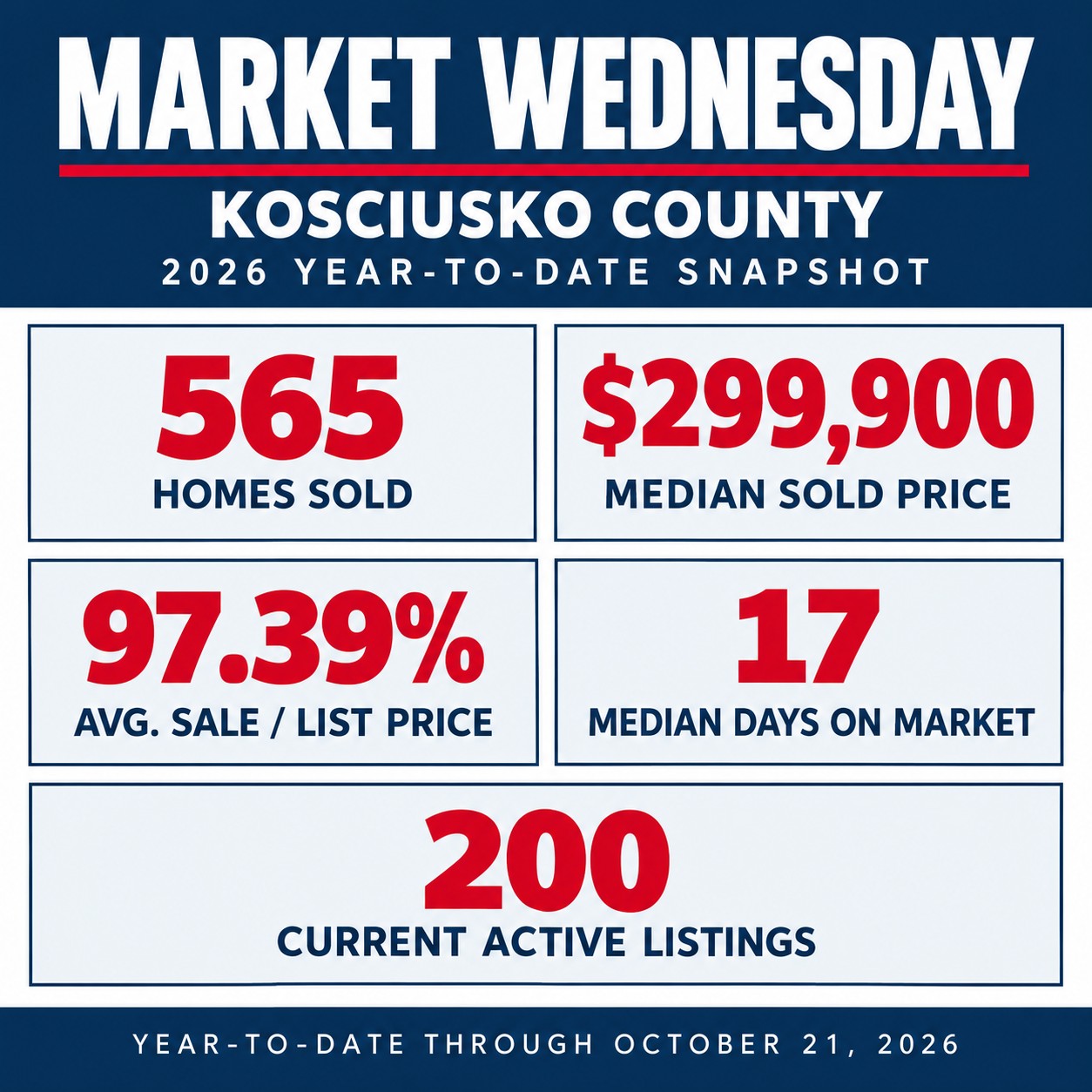
Local Real Estate Market as of October 21, 2026

What’s happening in the Kosciusko County housing market?

Here’s a quick look at the numbers!
Current information straight from the Kosciusko County MLS as of October 21, 2026.
Real numbers. Local market. No guesswork.

Community • October 19, 2026

Sometimes You Just Have to Laugh at the Goats!

PORCHLIGHT CONVERSATION
Sometimes You Just Have to Laugh at the Goats!

Friday morning, I was driving down SR 13 on my way to work when I spotted something that made me do a double take.

GOATS!

Not just one or two, either. A whole bunch of them! A couple were standing up on their hind legs against the fence, looking like they were checking out the neighborhood.

I thought I was seeing things!

Later that afternoon, I drove past again, and one of those little characters was perched up on something, surveying the world like he owned the place.

Well, naturally, I had to investigate.

It turns out the Wawasee Area Conservancy Foundation has brought in a herd of goats to help clear invasive vegetation near the Ruddell Pavilion. They’re nature’s own little landscaping crew, happily munching away at plants that need to go.

What a clever way to help care for our local environment!

Now, I happen to have a little history with goats. And one particular billy goat and I had a rather memorable encounter.

Years ago, when I was working as a real estate appraiser trainee with my mother, we were inspecting a farm. Mom handled gathering and verifying the property information, and I was responsible for the photographs.

We had finished the house and driven down to the barn so I could photograph it. My mother and stepdad stayed in the car while I went to investigate.

The barn door was open, and there was enough light inside to get some pictures.

And there he stood.

The cutest little billy goat!

He had a rope hanging from his neck, so naturally, I assumed he was tied up.

I started talking to him.

You know, the way you talk to an adorable animal.

He took a couple of steps toward me.

I kept talking.

He took a few more steps.

And that’s when I noticed something rather important.

HE WAS DRAGGING THE ROPE BEHIND HIM.

It wasn’t tied to a darn thing!

Now, this little fellow had some pretty impressive curved horns, and I was beginning to reconsider my decision to make friends.

But I also knew better than to turn and run. I could just picture myself falling flat on my face with a billy goat standing over me!

So I kept talking calmly while slowly trying to make my way back toward the car.

He kept coming.

Then he lowered his head.

Oh, crap.

This was it.

But instead of charging me, he gently pressed his head against my stomach and started walking.

And walking.

And WALKING.

That billy goat escorted me all the way back to my car!

When we got there, I thanked him for his assistance.

He turned around and went right back to the barn.

And I climbed into the car to find my mother and stepdad absolutely beside themselves laughing.

Especially my stepdad. If you knew Jerry, I am sure you can hear that rotten giggle right now too!

I looked at the two of them and said, “There were TWO of you sitting here, and neither one of you did a darn thing to help me!”

Apparently, they thought the whole thing was hilarious.

Looking back, I have to admit, it was.

So when I spotted those goats along SR 13 Friday morning, I couldn’t help but smile.

And I learned something about an organization I’ve driven past countless times but haven’t really taken the time to explore.

The Wawasee Area Conservancy Foundation does important work protecting our local lakes and watershed, and sometimes it takes a herd of adorable goats to get people curious about what’s happening right in their own backyard.

If you get a chance, take a look at what they’re doing. Here’s the story about their newest four-legged employees:

WACF Has Gone To The Goats

And if you see those goats along SR 13, give them a little wave from me.

I’ll be admiring them from the other side of the fence. I’ve already been escorted off one property by a billy goat, and once was quite enough!

Frequently Asked Friday - Property Taxes • October 15, 2026

Frequently Asked Friday: Indiana Property Taxes — Part 3 of 5

Property Tax Deductions and Credits: Are You Receiving the Benefits You’re Entitled To?

We’ve talked about how Indiana property taxes work, where the money goes, and how assessed values are determined.

But here’s a question that deserves just as much attention:

Are you receiving every property tax benefit you’re eligible for?

The assessed value of your home is only part of the equation. Indiana offers deductions and credits that can reduce what qualifying property owners owe.

And with changes to Indiana’s property tax laws taking effect over several years, it’s more important than ever to understand which benefits apply to you.

Let’s take a closer look.

First, What’s the Difference Between a Deduction and a Credit?

These two terms sound similar, but they work differently.

A deduction reduces the assessed value of your property that is subject to taxation.

A credit reduces the amount of property tax you owe.

For example, imagine your home has an assessed value of $250,000. A deduction may reduce the value used to calculate your taxes. A credit, on the other hand, reduces the resulting tax bill.

Both can provide meaningful relief, but eligibility and calculations depend on the particular benefit.

The Homestead Deduction: Where Most Homeowners Should Start

If you own and occupy your Indiana home as your principal residence, you may qualify for the homestead deduction. This is one of the most important property tax benefits available to Indiana homeowners.

Your principal residence is generally the home where you actually live—not a vacation property, second home, or investment property.

Indiana’s homestead provisions include a standard deduction and a supplemental deduction. The amounts and percentages are changing under legislation adopted in 2025, with changes being phased in over multiple assessment years.

For example, for the 2026 assessment year, with taxes payable in 2027, the standard homestead deduction is $40,000, while the supplemental deduction is calculated at 46% of the remaining qualifying homestead assessed value.

The important takeaway is that your deductions affect the taxable value of your home, not necessarily the value shown on your assessment notice.

What should you do? Check your property tax statement to make sure your homestead benefit is listed if you’re eligible.

If you recently purchased a home, changed ownership, transferred property into a trust, or changed your principal residence, confirm that the county auditor has the correct information.

And remember: owning a home doesn’t automatically mean every benefit has been properly recorded.

Property Tax Relief for Older Homeowners

Indiana also provides property tax credits for qualifying older homeowners.

The Over 65 benefit is subject to requirements that can include age, income, ownership, residency, and other statutory conditions.

One important recent change is that certain benefits previously structured as deductions have been converted into credits. That means an older homeowner looking at a past tax statement may see different terminology on a newer bill.

If you’re approaching age 65, already over 65, or helping an older family member manage their finances, it’s worth reviewing the current requirements with the county auditor.

Don’t assume that a benefit is unavailable simply because you didn’t qualify several years ago—or that the rules have stayed exactly the same.

Benefits for Blind or Disabled Homeowners

Indiana also offers a property tax credit for certain qualifying blind or disabled individuals.

Eligibility and documentation requirements apply, and the benefit may be affected by other credits or limitations.

This is another area where recent legislation has changed how relief is provided. If you believe you or a family member may qualify, ask the county auditor about the current blind or disabled property tax credit.

An Important Update for Indiana’s Disabled Veterans

This is one of the most significant changes I want homeowners to know about.

Beginning with the 2026 assessment year, for taxes payable in 2027, certain qualifying totally disabled veterans may receive a deduction equal to 100% of the assessed value of their principal residence.

That can eliminate the assessed-value-based property tax on the qualifying home. However, it does not necessarily eliminate every charge on a tax statement or taxes attributable to property that does not qualify.

Eligibility requirements include:

  • At least 90 days of military service.
  • An honorable discharge.
  • Total disability supported by qualifying documentation.
  • Indiana residency for at least one year before the applicable assessment date.
  • Ownership or qualifying purchase of the property used as the veteran’s principal residence.

The total disability requirement does not necessarily mean the disability must be service-connected.

There is another critical detail: qualifying veterans who received a previous veteran deduction generally must submit a new application to receive the amended 100% deduction for taxes payable in 2027.

Do not assume the new benefit will simply replace the old one without action.

Indiana also provides other veteran property tax credits, including:

  • A $350 credit for qualifying honorably discharged wartime veterans with a service-connected disability rating of at least 10%.
  • A $250 credit for qualifying honorably discharged veterans age 62 or older who served at least 90 days and have a disability rating of at least 10%.

An eligible veteran may qualify for both credits, but someone receiving the new 100% deduction cannot also receive these local veteran property tax credits. Certain surviving spouses may qualify for benefits as well.

The application deadline for these veteran benefits for taxes payable in 2027 is January 15, 2027.

Veterans should contact their County Veterans Service Officer or County Auditor as soon as possible to review eligibility and required documentation.

What About Lake Homes and Second Homes?

Here in Kosciusko County, this question is especially relevant.

Many property owners have a primary residence somewhere else and a cottage or lake home here.

A second home generally does not qualify for the homestead deduction simply because you own it, spend summers there, or pay property taxes in Indiana.

Homestead eligibility depends on the property being your qualifying principal residence. And if you move permanently into your lake home, that change may affect your eligibility.

This is an excellent reason to contact the county auditor whenever your primary residence changes.

How Can You Tell What Benefits You’re Receiving?

Start with your most recent property tax statement.

Look for the section identifying deductions, credits, and taxable assessed value. Then ask yourself:

  1. Is my homestead benefit listed correctly?
  2. Have I recently reached an age or experienced a change that could affect eligibility?
  3. Do I or a family member qualify for disability-related benefits?
  4. Am I a veteran or surviving spouse who should review the new rules?
  5. Have I recently bought, sold, inherited, or changed ownership of a property?

If something doesn’t look right, don’t guess.

Contact your County Auditor’s Office. That office can explain the records associated with your property, current filing requirements, and available applications.

Official Resources for More Information

I’ve included these government resources so you can review the requirements directly:

These resources are especially important because the law and its implementation can change. Information in this article reflects guidance available as of October 15, 2026.

One Final Thought

Property taxes can be confusing, and the changes happening in Indiana aren’t making them any easier to understand.

But homeowners deserve to know how their taxes are calculated and what benefits may be available to them.

You don’t have to become a property tax expert. You just need to know which questions to ask and where to find reliable answers.

And sometimes, that starts with taking another look at the tax bill you’ve been paying for years.

In Part 4 of our five-part series, we’ll look at property tax rates, tax caps, and how the final bill comes together.

Because understanding your property’s value is one thing. Understanding what you actually owe is another.

From your friend who is a Realtor,

Toni Derry, REALTOR® | ABR
ERA Crossroads
Local. Responsive. Reliable.

This article is provided for general educational purposes and is not legal or tax advice. Individual eligibility and tax calculations should be confirmed with the appropriate county officials or qualified professionals.

Market Wednesday • October 14, 2026

What is Available to Purchase in Kosciusko County on October14, 2026

MARKET WEDNESDAY
What’s Available in Kosciusko County RIGHT NOW?

We often talk about what homes have sold for, how quickly they’re selling, and where prices are headed.
But today, let’s look at something a little different.

What’s actually available to BUY?
As of October 13, 2026, Kosciusko County has 204 active residential listings with no contingencies.

LET’S BREAK IT DOWN BY PRICE
51 properties priced at $250,000 or less
98 properties priced from $250,001 to $500,000
55 properties priced above $500,000

LOOKING FOR SOMETHING SPECIFIC?
94 properties in Warsaw Community Schools
84 properties in Wawasee Community Schools
36 homes that are 10 years old or newer
107 single-story/ranch homes
45 properties with one acre or more

NOW, LET’S TALK LAKEFRONT!
There are currently 43 lakefront properties available in Kosciusko County, including 12 condominiums.
And here’s something that might surprise you:
7 lakefront properties priced under $250,000
24 priced under $500,000, including 8 condos
33 priced under $1,000,000, including 11 condos
These price ranges are cumulative, not separate groups.

WHERE ARE THOSE LAKEFRONT PROPERTIES?
Barbee Chain — 7
Tippecanoe Lake — 5 (2 condos)
Lake Wawasee — 9 (6 condos)
Winona Lake — 3 (2 condos)
Big & Little Chapman Lakes — 2
Webster Lake — 4
Papakeechie Lake — 2
Syracuse Lake — 2 (1 condo)

HERE’S WHY LOCAL KNOWLEDGE MATTERS.
When researching these numbers, I found properties categorized as waterfront that were actually on a pond, a river, or offered lake access rather than direct lake frontage.

Lakefront, lake access, riverfront, and pond frontage can offer very different ownership experiences. Understanding exactly what you’re looking at is just as important as knowing the asking price.
The numbers tell us what’s available. Local knowledge helps us understand what those numbers really mean.
Whether you’re searching for your first home, hoping for fewer stairs, looking for more acreage, or dreaming of lake life, there may be more possibilities than you realize.

Have a question about a particular neighborhood, school district, lake, or price range? I’d love to help you explore your options.

Toni Derry, REALTOR® | ABR
ERA Crossroads

Market snapshot effective October 13, 2026. Based on active residential listings without contingencies in Kosciusko County. Inventory and pricing are subject to change. Property categories may overlap.
#MarketWednesday #KosciuskoCountyRealEstate #ERACrossroads #ToniDerryRealtor #SyracuseIndiana #WarsawIndiana #NorthWebsterIndiana #IndianaLakeHomes

Frequently Asked Friday - Property Taxes • October 9, 2026

How Are Property Tax Assessments Calculated in Indiana – Part 2 of 5

Frequently Asked Friday: Let’s Talk Property Taxes
Part 2 of 5 — How Did They Come Up With THAT Assessment?

Last Friday, we started talking about property taxes—how they’re calculated and where the money goes.

Missed Part One? Start with our introduction to property taxes: https://toniderry.sites.erarealestate.com/2026/10/08/part-one-of-five-property-tax-discussion

This week, let’s tackle something nearly every homeowner has wondered:

“How in the world did they decide my house is worth THAT much?”

In Indiana, property assessments are based on something called market value-in-use

That’s the value of your property for the purpose it’s being used for. For a residential property, that means its value as a home.

But how do they arrive at that number?

Assessors consider factors such as square footage, age, construction quality, condition, improvements, land, and location.

Indiana also uses a process called annual trending

That means assessors study property sales in an area and use that information to determine whether assessed values need to be adjusted to reflect changes in the real estate market.

Here’s what surprises some homeowners:

Your assessed value can increase even if you haven’t changed a single thing about your house.

You haven’t remodeled the kitchen. You haven’t added a garage. You haven’t even painted the living room.

But if property values in your area have increased, your assessment may increase, too.

And the reverse can happen when market conditions change.

Now, let me put on my REALTOR® hat for a minute.

Your assessed value and what your home would actually sell for aren’t necessarily the same number.

Assessments use standardized valuation methods. An individual property’s selling price depends on what buyers are willing to pay for its particular features and condition.

We see this especially in our lake communities. Two homes can look similar on paper, but differences in frontage, water access, location, condition, and other features can make a substantial difference in what buyers will pay.

So, what if you think your assessment is wrong?

Here’s where you can do a little homework of your own.

Step 1: Look up your property.

For Kosciusko County, visit Beacon:

https://beacon.schneidercorp.com/

Select Indiana, then Kosciusko County. Search by your address, name, or parcel number.

Step 2: Find your property record card.

This is where you can review the information the assessor has about your property.

Look at the square footage, land details, buildings, improvements, and other recorded characteristics.

Is the information accurate?

Are you being assessed for something that doesn’t exist? Is the square footage wrong? Is an improvement incorrectly recorded?

Step 3: Compare your assessment with reality.

Ask yourself whether your property could reasonably have sold for approximately its assessed value as of the relevant assessment date.

Consider actual sales of similar properties, not just asking prices.

And remember, a neighbor’s property might not be as comparable as it first appears.

Step 4: Ask questions.

If something doesn’t look right, contact the Kosciusko County Assessor’s Office.

Phone: 574-372-2310

You can also visit the county’s website:

https://www.kosciusko.in.gov/

Sometimes a conversation and a review of your property record can help explain what you’re seeing.

Step 5: Know your appeal rights.

Indiana property owners have the right to challenge an assessment through a formal appeal process using Form 130.

But there are filing deadlines, and those deadlines depend on when the assessment notice was mailed.

For many assessments, the deadline is June 15, but don’t assume that date applies to your particular situation. Check your assessment notice and verify the applicable deadline with the assessor.

You can find official appeal information and forms through the Indiana Department of Local Government Finance:

https://www.in.gov/dlgf/

And one more thing: You do not have to hire an appraiser simply to file an assessment appeal. Supporting evidence matters, but Indiana does not require a formal appraisal to initiate the process.

Now, here’s something else worth understanding.

An increase in assessed value doesn’t necessarily mean your property tax bill will increase by the same percentage.

Tax rates, deductions, credits, and Indiana’s property-tax caps are also part of the equation.

And that brings us to next Friday.

Part 3: Deductions, Credits, and Property-Tax Caps — Are You Getting the Benefits You’re Entitled To?

My goal with this series isn’t to tell anyone whether property taxes are good, bad, too high, or too low.

It’s to help us understand how the system works so we can ask better questions and make informed decisions.

And if you start digging into your property information and find yourself overwhelmed, you’re welcome to reach out. I may not have every answer, but I’m happy to help you understand the real estate side and point you toward the right resources.

No politics. No telling you what to think.

Just information.

Your friend who happens to be a REALTOR®

Toni Derry, REALTOR® | ABR®
ERA Crossroads

Frequently Asked Friday - Property Taxes • October 8, 2026

Part One of Five – Property Tax Discussion

Frequently Asked Friday: Let’s Talk Property Taxes

Property taxes are everywhere in the conversation right now, and I keep hearing questions about what they are, how they’re figured, and what exactly we’re paying for.

So for the next few Fridays, we’re going to talk about it. I’m not going to tell you how to vote or what to think. I just think it’s easier to have an opinion when we understand what we’re talking about.

So let’s start really simple.
Your property has an assessed value. After any deductions that apply to you, that leaves your taxable value.
A local tax rate is applied to that amount, and then things like credits and Indiana’s property-tax caps help determine what you actually owe.
That’s the simplified version. There are more moving parts—we’ll get to those.

Now, where does the money go?

This is one I think gets confusing. When you pay property taxes in Kosciusko County, all of that money doesn’t just go to “the county.” Depending on where you live, your property taxes help support different local taxing units—county government, your city or town if you live in one, your township, schools, libraries and other local services. Think roads and infrastructure, police and fire protection, libraries, local government and portions of our school system.

So when we’re talking about changing—or even eliminating—property taxes, there’s another question that has to be part of the conversation: What replaces the money? Because for every action, there is a reaction.

We’re going to work our way through this together over the next few Fridays—one piece at a time and in plain English.

Next week, let’s tackle something almost every homeowner has wondered:
How did they come up with THAT assessment?
No politics. No telling you what to think.
Just information.
Your friend who happens to be a REALTOR®