
 Facebook
 X
 Pinterest
 Copy Link
Part Two of Our Home Inspection Series
You’ve found the house. You love it. Your offer has been accepted!
You’re excited! You’ve probably already imagined where your furniture will go, what color you’ll paint the living room, and how wonderful it will feel to finally have the keys.
But somewhere in the back of your mind, there’s a little voice asking, “What if I’ve made a mistake?”
After all, you’ve just made one of the biggest financial decisions of your life.
And now comes the home inspection.
Before You Panic, Let’s Talk About That Inspection Report
A home inspector walks through the property, examines accessible systems and components, takes photographs, and prepares a report.
And sometimes that report is LONG!
Pages of observations, photographs, recommendations, and color-coded warnings.
Suddenly, the house you fell in love with looks like it might be falling apart.
But is it?
Here’s something I want every buyer to understand: You’re purchasing a previously owned home. You’re not purchasing a brand-new home.
That home has been lived in. Things have aged. Repairs have been made. Maintenance has been performed, and there may be additional maintenance needed.
That doesn’t necessarily mean it’s a bad house.
Understanding What the Inspector Is Telling You
Many inspection reports use a color-coded system to help buyers understand the seriousness of their findings.
While reporting systems vary between inspection companies, you may see categories similar to these:
RED — Immediate Attention
Potential safety hazards, significant defects, or conditions requiring prompt evaluation or repair.
YELLOW — Attention May Be Needed
Items that may be functioning but need maintenance, monitoring, further evaluation, or repairs in the foreseeable future.
GREEN — Functional or Informational
Components that appear to be functioning or observations the buyer should simply be aware of.
These categories can be helpful, but remember that the colors themselves don’t determine what the seller must repair.
A red item deserves careful attention. A yellow item may need additional investigation. And a green item doesn’t guarantee that a component will never fail.
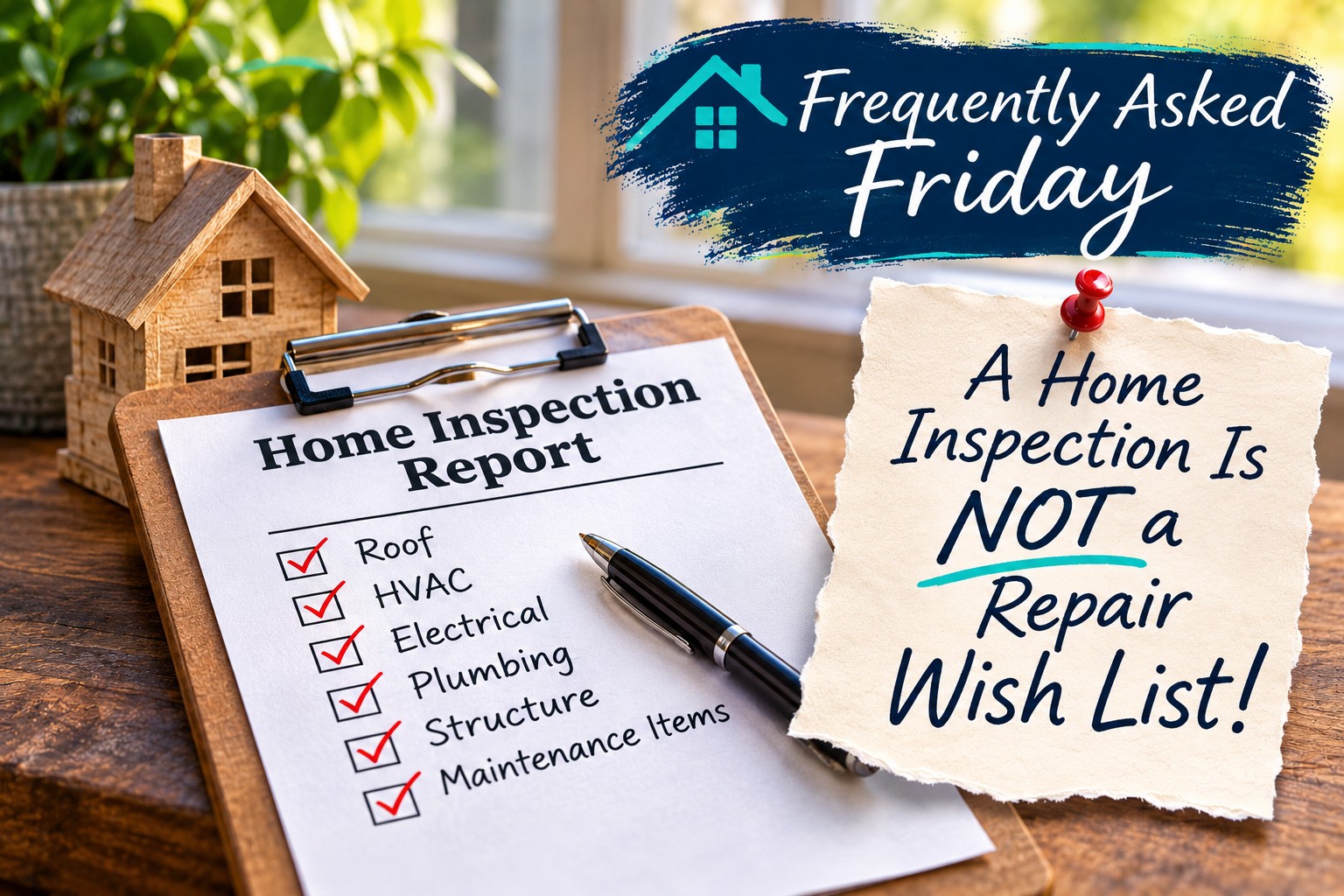
An inspection report is information. It is not automatically a repair order for the seller.
Not Every Item Deserves the Same Response
Let’s say your inspection identifies a loose doorknob, a dripping faucet, an aging furnace, and a potentially serious electrical concern.
Should all four items carry the same weight?
Of course not.
The electrical concern may require evaluation by a licensed electrician. The furnace may warrant servicing or an estimate for replacement. The faucet and doorknob might simply become part of your future maintenance list.
The important thing is to understand what you’re dealing with before deciding what to request from the seller.
And remember, some findings may be significant enough to reconsider purchasing the property altogether.
Does the Seller Have to Fix Everything?
No. Not automatically.
The seller’s responsibilities depend on the purchase agreement, any negotiated inspection provisions, and applicable requirements.
Buyers may have the opportunity to request repairs, negotiate other solutions, or exercise contractual options if an agreement cannot be reached.
But an inspection isn’t an opportunity to automatically require the seller to make an older home equivalent to new construction.
And sellers shouldn’t feel bullied into making every repair on a lengthy inspection report.
Both parties deserve reasonable expectations and respectful negotiations.
Sometimes a Price Reduction Makes Sense
Imagine the inspector identifies a roof that needs replacement.
You obtain a professional estimate, and the cost is approximately $8,000.
Depending on the circumstances, you and the seller might negotiate a reduction in the purchase price rather than having the seller replace the roof.
That could be a reasonable solution if you’re comfortable arranging the work and have sufficient funds available.
But here’s something buyers sometimes overlook.
An $8,000 reduction in the purchase price doesn’t put $8,000 in your checking account to pay the roofer.
It may reduce your mortgage payment slightly, but you could still need the full repair amount shortly after closing.
And that brings us to something especially important.
Your Financing Can Make a Difference
For first-time homebuyers, buyers using down payment assistance, or those purchasing with limited cash reserves, having the seller complete certain repairs before closing may be a much better solution than negotiating a lower price.
Why?
Because you may not have the extra money available to make those repairs after purchasing the home.
And depending on your loan program, some property conditions may have to be corrected before financing can be completed.
FHA, VA, USDA, conventional financing, and down payment assistance programs may have different property-condition requirements.
Some repairs may need to be completed before closing, with appropriate documentation or verification provided.
A price reduction alone may not satisfy the lender’s requirements.
That’s why it’s important to involve your lender in the conversation before deciding how to handle significant inspection findings.
What If the Seller Agrees to Make Repairs?
If repairs become part of the negotiated agreement, it’s important to be specific.
What exactly will be repaired? Who will complete the work? When must it be finished? Will permits, receipts, warranties, or other documentation be required? Will the work need to be reinspected?
These details should be addressed in writing.
The goal is to avoid misunderstandings and make sure the agreed-upon work is completed appropriately.
Sellers Have Feelings, Too!
While buyers are worrying about whether they’ve made the right decision, sellers may be worrying about whether their sale is going to fall apart.
They’ve made plans. Perhaps they’re purchasing another home, relocating, downsizing, or settling an estate.
Then they receive a lengthy list of requested repairs.
It’s understandable that they may feel frustrated or overwhelmed.
A successful negotiation shouldn’t be about one side winning and the other losing.
It’s about identifying legitimate concerns, understanding the available options, and working toward an agreement both parties can accept.
My Perspective
I believe a home inspection is one of the most valuable tools available to a buyer.
But I also believe it’s important to understand what that inspection is intended to accomplish.
The inspector’s job is to evaluate and report on the home’s condition within the scope of the inspection.
The buyer’s job is to consider that information and decide whether the property is still the right choice.
The seller has decisions to make, too, when repair requests are presented.
And my job as your REALTOR® is to help you understand the process, communicate your concerns, explore your options, and navigate negotiations.
The goal of a home inspection isn’t to find a perfect house. It’s to understand the house you’re buying and make informed decisions about what comes next.
Buying or selling a home involves some big decisions. You don’t have to navigate them without guidance.
Toni Derry, REALTOR® | ABR
ERA Crossroads Real Estate
Serving Kosciusko County and the surrounding lake communities
Inspection findings, repair obligations, financing requirements, and contractual rights vary by transaction. Buyers and sellers should consult qualified inspectors, contractors, lenders, and other appropriate professionals when evaluating specific concerns.
